C481 B581 Computer Graphics
Dana Vrajitoru
Interpolating Curves and Surfaces
Interpolating Curves
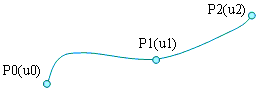
- Simplest case: given a list of points P0,
P1, P2, ..., draw a curve that passes through
each of them in this order.
- Usually this is done by a polynomial function of degree the number
of points - 1.
- We can also interpolate on subsets of points and concatenate the
resulting curves.
- We can also impose the continuity of the derivative up to a
certain point to insure the smoothness of the curve.
- The first derivative of the function defining the curve
parametrically is the tangent to the curve. The second derivative
gives us the curvature.
Bezier Curves
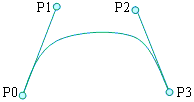
Some of the control points are used to define the tangent to the
curve.
Spine Curves
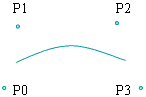
- Curves with continuity of the second derivative (curvature) with
local computations. The polynomial function is usually cubic.
- Each curve segment is defined by 4 control points, none of which
is actually on the curve itself.
- B-splines: bi-cubic.
Surfaces
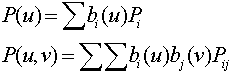
- Any interpolation type can be extended to surfaces by adding a
second parameter (v or t).
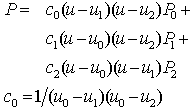
- bi(u) are called blending functions and they are
similar to the interpolation functions defined for 3 points.
- The best known are the NURBS surfaces (nonuniform rational
B-spline).
NURBS in OpenGL
GLUnurbsObj *nobj;
nobj = gluNewNurbsRendered();
gluBeginSurface(nobj);
gluNurbsSurface(nobj,
  nrk, knots, nr, knots, du, dv,
  points, 4, 4, surf_type);
gluEndSurface(nobj);
// type: GLU_MAP2_VERTEX_3
Triangulation
Def. Given a set of points or vertices V={v1,
v2, ..., vn}, find a set of triangles
T={t1, t2, ..., tm} such as:
- each triangle from T is based on vertices from V,
- for each triangle, no other point from V apart from its vertices
can be found inside it,
- the triangles form a convex surface containing all the points in V
triangle interiors do not intersect.
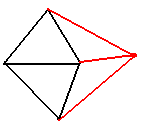
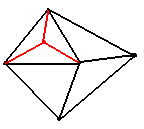
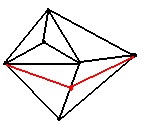
Lazy Algorithm
- Start with an arbitrary point.
- Find its two nearest neighbors.
- Add one point at a time.
- For each new point, add the triangles required for the surface to
remain convex.
Open and Interesting Problems
- Finding an optimal triangulation for a given object in polynomial
time, that minimizes the number of triangles, the total edge length,
or the total surface area.
- For OpenGL: finding a minimal number of triangle strips covering
the object.
- Resolution problems: reducing the number of triangles without
losing details.
- Related problems: convex boundary for a given number of points,
polygonal or circular (spherical).
- Object morphing: computing the number of flips required to convert
one planar triangulation into another.
- Fast remeshing after a local change.